
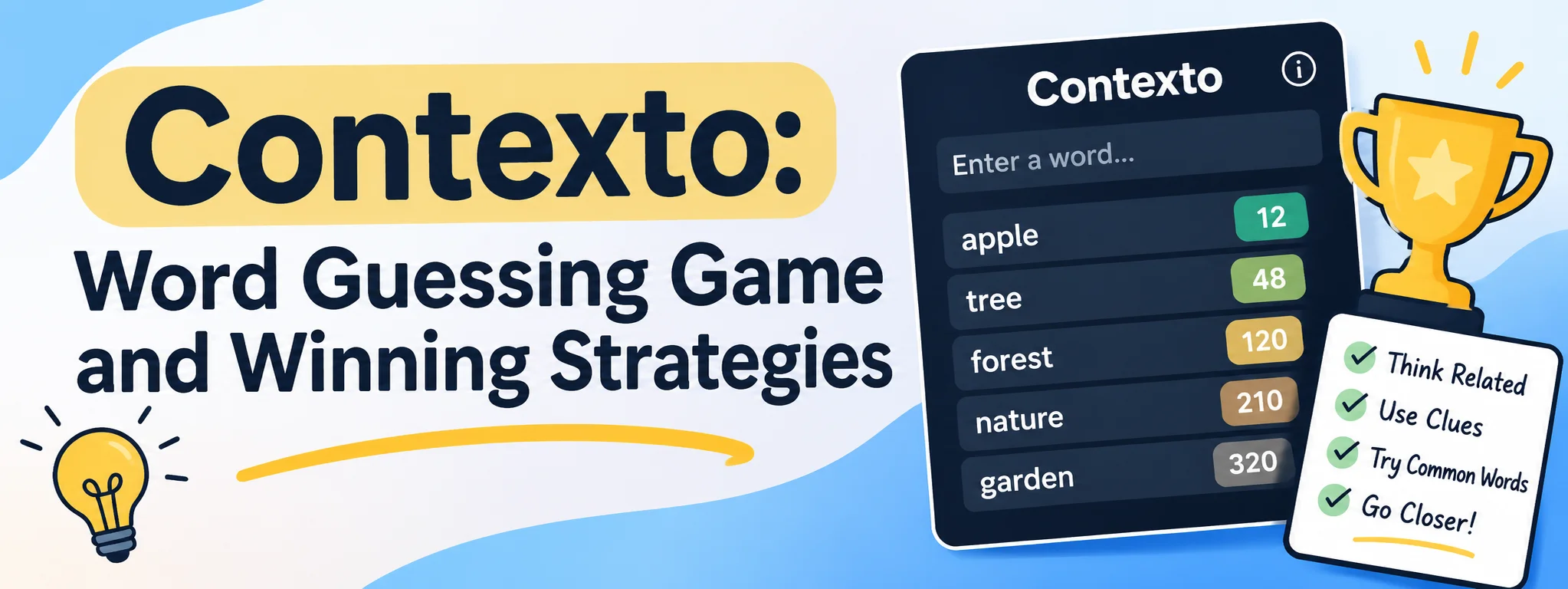
Contexto is an engaging word-guessing game that challenges players to think beyond ordinary vocabulary and discover hidden connections between words. Instead of relying on spelling patterns or matching letters, Contexto uses the meaning and context of words to guide players toward a secret answer. This unique approach makes the game both entertaining and mentally stimulating for people who enjoy language puzzles.
Unlike traditional word games, Contexto focuses on semantic relationships. Players enter different words and receive rankings that indicate how closely each guess relates to the hidden word. A guess might not share any letters with the correct answer, yet it could still be closely connected through meaning, usage, or context.
Whether you are discovering Contexto for the first time or looking for better ways to solve its daily challenges, understanding its gameplay, ranking system, and strategic techniques can make the experience more rewarding. This guide explores the game’s main features, practical tips, common mistakes, and ways to improve your word-guessing skills.
Understanding the Contexto Word Game
Contexto is a word puzzle built around the relationship between language and meaning. The main objective is to identify a secret word by submitting guesses and studying their positions in the game’s ranking system.
The game uses artificial intelligence and language-based relationships to evaluate how words relate to one another. Rather than checking whether two words contain similar letters, it considers how words are connected in everyday language.
For example, if the hidden answer is related to cooking, guesses such as kitchen, recipe, chef, ingredient, and restaurant might receive relatively close rankings. These words belong to a similar subject area, even though their spelling and structure are different.
This creates an interesting challenge because players must understand the broader meaning of their guesses instead of simply searching for matching letters.
How Contexto Works
The basic gameplay is straightforward, making Contexto accessible to beginners while still offering a challenge to experienced puzzle enthusiasts.
1. Enter Your First Guess
Start by entering a word that you think might have some connection to the hidden answer. Your first guess does not need to be perfect. It simply provides a starting point for exploring possible meanings.
Broad words related to common activities, objects, places, or concepts can help establish an initial direction.
2. Check Your Ranking
After submitting a guess, Contexto provides a numerical ranking. This number represents how closely your word is associated with the secret answer according to the game’s language model.
A lower ranking generally means that your guess is closer to the target. The correct answer receives the highest possible position.
For example:
- A ranking of 5 indicates a very close relationship.
- A ranking of 150 suggests a potentially useful connection.
- A ranking of 2,000 indicates a more distant relationship.
These numbers are illustrative rather than guaranteed ranking ranges. Actual results depend on the hidden word and the game’s ranking system.
3. Explore Related Words
Your previous guesses provide clues for the next attempt. If several words receive relatively close rankings, examine their shared meanings.
Suppose words such as doctor, hospital, nurse, and medicine receive promising results. Instead of randomly guessing unrelated terms, explore the healthcare category more deeply.
Possible next guesses might include patient, treatment, surgeon, clinic, or diagnosis.
4. Find the Hidden Answer
Continue testing related vocabulary until you discover the secret word. Each attempt helps you understand the possible subject and narrow down the available choices.
The most effective approach is to use every ranking as information rather than treating guesses as random attempts.
Key Features That Make Contexto Interesting
Contexto offers a different experience from conventional word puzzles because it emphasizes meaning, interpretation, and vocabulary.
Semantic Word Relationships
The central feature of Contexto is its ability to recognize relationships between words. Two terms can be closely connected even when they have completely different spellings.
For example, the words ocean, beach, swimming, and vacation may share a common theme. Understanding these connections is essential for making progress.
Ranking-Based Feedback
The ranking system provides continuous feedback after each guess. Players can compare their results and determine whether their latest attempts are moving closer to the target.
This makes the game feel like a process of investigation rather than a simple vocabulary test.
Vocabulary Development
Playing Contexto regularly encourages people to explore unfamiliar words and think about different meanings. It can also help players recognize relationships between nouns, verbs, adjectives, and broader concepts.
Flexible Guessing Strategies
There is no single path to the answer. Some players prefer beginning with broad categories, while others test specific words and gradually expand their vocabulary based on the results.
This flexibility allows everyone to develop a personal solving method.
Best Strategies to Improve Your Contexto Performance
Getting better at Contexto requires more than knowing a large number of words. The key is to make thoughtful guesses, recognize patterns, and use feedback effectively.
1. Begin With Broad Categories
Avoid starting with extremely specific words unless you already have a strong idea about the hidden answer.
Try general categories such as:
- Food and cooking
- Nature and animals
- Technology and communication
- Education and employment
- Travel and transportation
Broad guesses can help identify the general subject before you begin exploring smaller groups of related terms.
2. Follow Your Closest Rankings
One of the most useful techniques is to focus on guesses that receive better rankings.
If a word performs well, explore its synonyms, associated objects, common activities, and related situations.
For example, if the word teacher receives a promising ranking, consider classroom, student, school, lesson, education, and examination.
Do not abandon a promising direction simply because your first few related guesses are not successful.
3. Think About Different Contexts
Words can have several meanings depending on how they are used.
Consider the word bank. It can refer to a financial institution, a riverbank, or a collection of something. If your guesses suggest multiple possible interpretations, explore the different meanings before choosing one direction.
This approach can uncover connections that are not immediately obvious.
4. Use Synonyms and Related Expressions
Synonyms are useful, but Contexto also rewards exploring words that frequently appear in similar situations.
For example, if the word hospital produces a strong ranking, trying doctor, patient, medicine, emergency, surgery, and treatment may provide additional clues.
The goal is to explore the entire conceptual neighborhood rather than repeatedly guessing words with almost identical definitions.
5. Keep Track of Previous Attempts
Remembering your earlier guesses prevents unnecessary repetition and helps you identify patterns.
Pay attention to which categories consistently produce stronger rankings. You can mentally organize guesses into groups and compare their performance.
This simple habit makes the solving process more organized and reduces random guessing.
Common Mistakes to Avoid While Playing Contexto
Even experienced players sometimes struggle because they rely on ineffective guessing habits. Avoiding these mistakes can improve your overall experience.
Guessing Without a Clear Direction
Entering unrelated words repeatedly rarely creates a useful strategy. Every guess should test a possible connection or provide information about the hidden subject.
Ignoring Good Rankings
A relatively strong ranking is valuable information. Moving to a completely different category without exploring it can waste an opportunity.
Focusing Only on Synonyms
The answer might not be a direct synonym of your closest guess. It could be an object, activity, person, location, or concept associated with that word.
Repeating Similar Guesses
Entering several words with almost identical meanings may provide limited additional information. Explore different relationships instead of making minor vocabulary changes.
Forgetting Multiple Word Meanings
A familiar word can have several interpretations. Considering alternative meanings can reveal connections that a narrow approach might miss.
Contexto Compared With Traditional Word Games
Contexto belongs to the wider family of word puzzles, but its meaning-based approach makes it different from games that focus on spelling, letter placement, or word patterns.
The following table highlights some important differences.
| Feature | Contexto | Traditional Word Games |
|---|---|---|
| Main focus | Word meaning and context | Letters and spelling |
| Player input | Individual words | Letters or complete words |
| Feedback | Numerical rankings | Color clues or letter hints |
| Main skill | Semantic reasoning | Vocabulary and spelling |
| Guessing method | Exploring related concepts | Testing letter combinations |
| Challenge | Understanding hidden relationships | Finding the correct word pattern |
This comparison is general because different traditional word games use different rules and feedback systems.
The biggest distinction is that Contexto encourages players to think about how words relate in real-life situations. A word can be useful even when it looks completely different from the final answer.
Why Contexto Is Popular Among Word Puzzle Fans
Word puzzles are popular because they combine entertainment with problem-solving. Contexto adds another layer by encouraging players to explore how language works.
It Encourages Critical Thinking
Players must evaluate each result and decide which direction deserves further exploration. This creates a continuous cycle of guessing, analyzing, and adjusting.
It Makes Vocabulary More Interesting
Learning new words becomes more enjoyable when vocabulary is connected to a practical challenge. Players encounter relationships they might not normally consider during everyday conversations.
It Offers a Different Daily Challenge
The search for a hidden word creates curiosity. Even a difficult puzzle can become satisfying when a previously confusing group of clues finally makes sense.
It Supports Short Gaming Sessions
Contexto can fit into a short break or a longer puzzle-solving session. Players can spend a few minutes experimenting with words or take additional time to examine more complicated relationships.
Practical Ways to Build Better Word Association Skills
Improving at Contexto does not require memorizing an entire dictionary. Developing stronger word associations can be more useful.
Here are five practical habits worth trying:
- Read regularly: Books, articles, and quality online content expose you to different vocabulary and expressions.
- Learn synonyms: Explore alternative words and understand how their meanings differ.
- Study word categories: Organize vocabulary around subjects such as science, business, nature, and everyday activities.
- Practice associations: Choose one word and list objects, actions, people, and situations connected to it.
- Review difficult guesses: Think about why a particular word received a distant ranking and what relationship you might have overlooked.
These habits can strengthen your general language skills while making future Contexto puzzles easier to approach.
Missing Information and Insights That Make Contexto Easier to Understand
Many basic explanations of Contexto concentrate on entering words and checking rankings. However, understanding the reasoning behind the feedback provides a more useful learning experience.
One important detail is that a close ranking does not necessarily mean two words are synonyms. Words may appear in similar contexts because they are frequently associated with the same activities, locations, or subjects.
Another important consideration is that rankings should be interpreted comparatively. A word’s position becomes more meaningful when you compare it with your other guesses.
Players should also understand that a language model’s associations do not always match ordinary human intuition. A seemingly unrelated word may receive a surprisingly close ranking because of patterns in language usage.
For a more effective solving process, consider maintaining three groups of guesses:
- Strong clues: Words with relatively low rankings that deserve further exploration.
- Supporting clues: Words that confirm a possible category or subject.
- Weak clues: Words that help eliminate unproductive directions.
This simple classification creates a more logical process and makes it easier to identify promising patterns.
Frequently Asked Questions
1. Is Contexto a free word game?
Contexto has been offered as a free online word puzzle. However, availability, features, and access conditions can change over time.
2. How does Contexto determine word rankings?
The game uses language-based relationships to compare guesses with the hidden answer. Rankings indicate the relative closeness of those associations.
3. Is Contexto similar to Wordle?
Both are word-guessing games, but their approaches are different. Wordle focuses on letters and their positions, while Contexto focuses on semantic relationships between words.
4. Can beginners play Contexto?
Yes. The basic rules are easy to understand, and beginners can improve by starting with broad categories and learning from each ranking.
5. What is the best strategy for solving Contexto?
Start with general words, identify promising rankings, explore related concepts, and avoid repeating guesses without a clear reason.
Final Thoughts
Contexto offers a refreshing approach to word puzzles by turning language and meaning into an engaging guessing challenge. Instead of relying on spelling patterns, players must explore relationships between concepts, interpret numerical rankings, and gradually identify the hidden answer.
The best way to improve is to approach every guess as a clue. Start with broad categories, follow promising results, explore synonyms and related concepts, and learn from unsuccessful attempts. With consistent practice, you can develop stronger word association skills and become more confident when solving difficult puzzles.